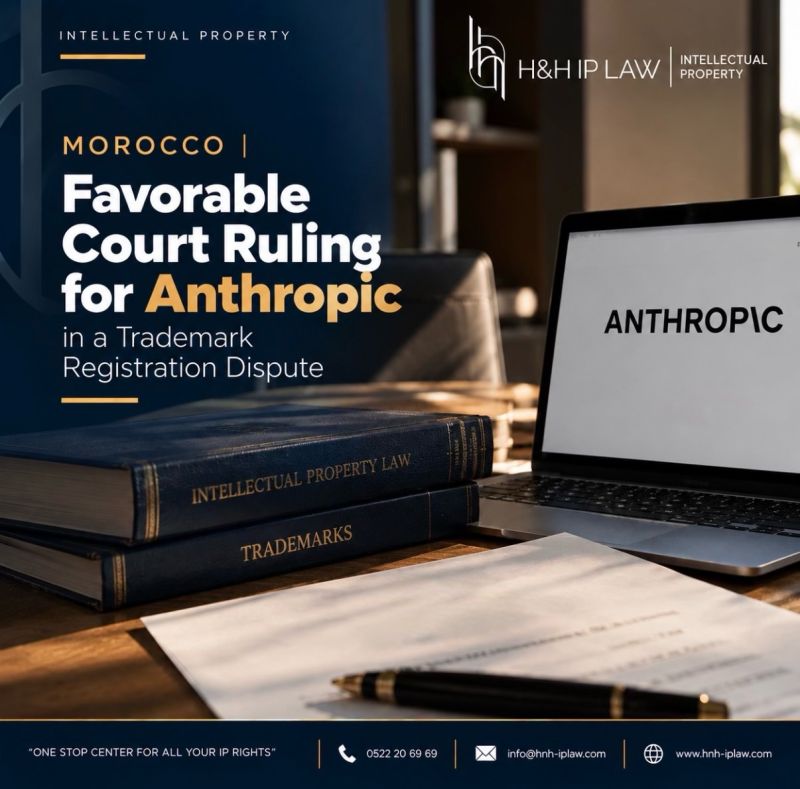
H&H IP LAW has secured a favorable ruling for Anthropic, the US-based artificial intelligence company behind Claude, in a trademark registration dispute in Morocco. The decision was delivered by the Casablanca Commercial Court of Appeal. It concerns the registration of the ANTHROPIC trademark. Furthermore, it involves the assessment of the likelihood of confusion between trademarks covering products from different economic sectors.
The Anthropic trademark dispute in Morocco highlights important principles of trademark law. In particular, it shows the need to assess the similarity of signs and goods in their commercial context rather than relying exclusively on their administrative classification.
Beyond the outcome of the proceedings, the case illustrates the importance of effective legal representation. It also shows the role of judicial review of administrative decisions and a carefully developed trademark protection strategy.
Background of the Anthropic Trademark Dispute in Morocco
As part of its ongoing representation of Anthropic, H&H IP LAW was involved in proceedings concerning the registration. These proceedings were about the ANTHROPIC trademark in Morocco.
The registration application was opposed by a Moroccan company holding an earlier trademark in the electrical equipment sector.
The opposition was based on alleged similarities between the signs and the resulting likelihood of confusion among consumers.
Following the administrative proceedings, the Moroccan Industrial and Commercial Property Office (OMPIC) accepted the registration of the ANTHROPIC trademark in Class 42. However, it refused protection in Class 9 of the Nice Classification.
Class 42 includes, among other services, technological services and certain software-related services. In contrast, Class 9 covers various goods, including downloadable software and certain artificial intelligence applications.
The partial refusal raised significant legal questions regarding the assessment of trademark similarity. It also raised questions about the relationship between the goods covered by the respective trademarks.
Trademark Opposition in Morocco: The Central Issue of Likelihood of Confusion
The central legal issue in the proceedings concerned the likelihood of confusion between trademarks.
In trademark opposition cases, assessing the likelihood of confusion generally requires an examination of several interconnected factors. These include the similarity of the signs, the relationship between the relevant goods or services, and the perception of the relevant public.
In the Anthropic case, the arguments presented before the Casablanca Commercial Court of Appeal focused particularly on the visual and phonetic differences. These differences existed between the conflicting trademarks.
The analysis also emphasized the differences between their respective commercial activities.
On the one hand, the ANTHROPIC trademark was associated with artificial intelligence software and technological solutions.
On the other hand, the earlier trademark relied upon in the opposition concerned products in the electrical equipment sector.
These distinctions were central to the legal arguments challenging the partial refusal of registration.
Nice Classification: Why Belonging to the Same Class Is Not Sufficient
One of the important legal aspects of the Anthropic trademark dispute in Morocco concerns the interpretation and application of the Nice Classification.
The Nice Classification, administered by the World Intellectual Property Organization (WIPO), establishes an international system. This system is used for classifying goods and services for trademark registration purposes.
However, classification serves primarily an administrative function.
The mere fact that two products fall within the same Nice class does not automatically establish that they are similar or that consumers are likely to confuse their commercial origin.
Likewise, goods or services classified in different classes may, depending on the circumstances, present relevant similarities.
A proper legal assessment should therefore consider the actual nature, purpose, intended users and commercial characteristics of the goods or services concerned.
In the proceedings involving Anthropic, the distinction between artificial intelligence software and electrical equipment formed an important part of the arguments. These arguments were presented before the Court.
This approach underscores the importance of moving beyond formal classification when assessing potential conflicts between trademarks.
The Role of Visual, Phonetic and Commercial Differences
The assessment of trademark similarity is not limited to identifying common letters, sounds or isolated elements.
A comprehensive examination may require consideration of the overall impression created by the signs, including their visual and phonetic characteristics.
Depending on the circumstances, conceptual differences may also be relevant.
The analysis must be considered alongside the relationship between the goods or services concerned. It must also include the characteristics of the relevant consumers.
In the Anthropic proceedings, the legal arguments emphasized the differences between the trademarks. Additionally, they highlighted the distinct economic sectors in which the relevant products were positioned.
The international recognition of the ANTHROPIC trademark and its use as a trade name were also presented in support of the appeal.
These considerations formed part of the broader legal argument. This argument challenged the assessment that had led to the refusal of protection in Class 9.
Casablanca Commercial Court of Appeal Rules in Favor of Anthropic
The appeal brought before the Casablanca Commercial Court of Appeal resulted in a favorable ruling for Anthropic.
The Court overturned the contested decision of the Moroccan Trademark Office. The decision concerned the refusal to register the ANTHROPIC trademark in Class 9.
This outcome represents an important development in the company’s efforts to secure protection for its trademark in Morocco.
It also illustrates the role of judicial review in trademark registration disputes. This is particularly true where an administrative decision is challenged on the basis of the assessment of conflicting signs and goods.
The case demonstrates that trademark opposition proceedings may involve complex questions. These often extend beyond the formal wording of the classes in which protection is sought.
A rigorous legal analysis of the relevant signs, products and commercial circumstances is therefore essential.
Key Lessons for Trademark Registration in Morocco
The outcome of the Anthropic proceedings offers several practical lessons for businesses seeking trademark registration in Morocco.
1. Trademark Similarity Requires a Comprehensive Assessment
The existence of certain similarities between two signs does not, by itself, resolve the question of likelihood of confusion.
The analysis must take account of the relevant legal and commercial circumstances.
2. Nice Classification Is Not a Substitute for Legal Analysis
Although the Nice Classification provides a standardized framework for trademark filings, it does not independently determine whether goods or services are similar.
Businesses should therefore carefully assess the actual scope of the goods and services covered by potentially conflicting trademarks.
3. Trademark Opposition Decisions May Be Subject to Judicial Review
Administrative decisions concerning trademark registration can raise substantial legal issues.
Where an applicable remedy is available, judicial review may provide an important mechanism for challenging a contested decision.
4. International Businesses Need a Local Trademark Strategy
For technology companies operating internationally, protecting a trademark in Morocco requires an understanding of the national legal framework. It also requires knowledge of administrative procedures and available judicial remedies.
An effective strategy should combine preliminary trademark searches, appropriate filing specifications, opposition management and, where necessary, litigation.
Trademark Protection in Morocco for Technology and Artificial Intelligence Companies
The development of artificial intelligence and digital technologies has increased the strategic importance of trademarks in the technology sector.
For companies offering software, AI platforms and digital services, trademarks are essential assets. These assets help identify the commercial origin of products and services.
They also contribute to brand recognition, customer confidence and long-term business value.
However, technology companies may face registration difficulties when their applications encounter earlier rights. These rights may cover goods or services that appear related at the classification level.
The Anthropic trademark dispute in Morocco illustrates why these situations require a detailed assessment. One must carefully assess the products concerned, the signs involved and their respective commercial environments.
A carefully structured trademark strategy can help companies anticipate potential conflicts and respond effectively when disputes arise.
H&H IP LAW: Protecting International Brands in Morocco
H&H IP LAW is pleased to have secured a favorable ruling for Anthropic before the Casablanca Commercial Court of Appeal in this trademark registration dispute.
The case reflects the importance of combining a thorough understanding of Moroccan trademark law. It also shows the value of a strategic approach to opposition proceedings and intellectual property litigation.
At H&H IP LAW, we advise and represent Moroccan and international clients in the protection, management and enforcement of their intellectual property rights.
Our services include trademark availability searches, national and international trademark registration, opposition proceedings, appeals, trademark litigation and the development of intellectual property protection strategies.
We remain committed to assisting innovative businesses and international brand owners in safeguarding their intellectual property assets in Morocco.
H&H IP LAW | Your Partner for Intellectual Property Protection in Morocco and Worldwide
Email: info@hnh-iplaw.com
Phone: +212 (0)5 22 20 69 69
Website: www.hnh-iplaw.com
One Stop Center for All Your IP Matters