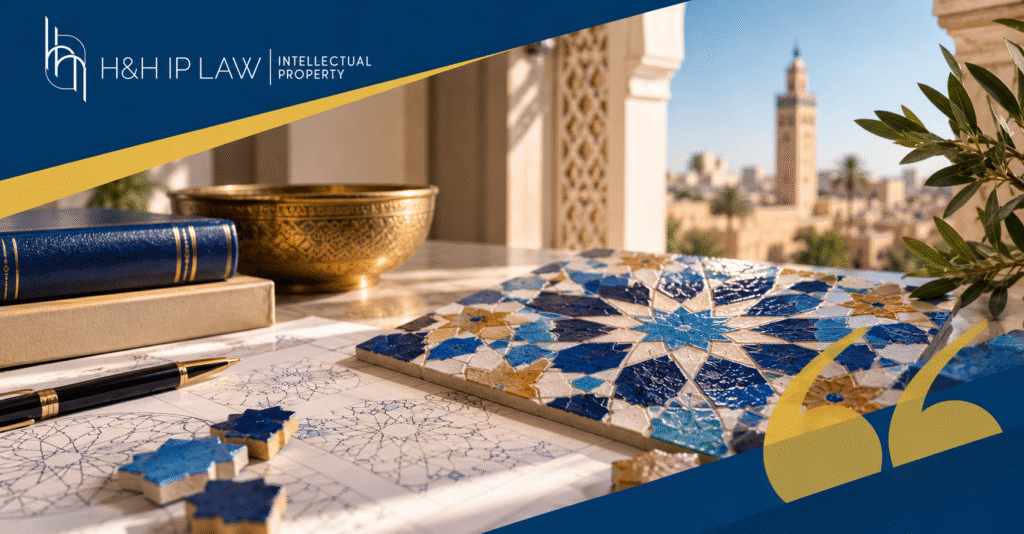
Moroccan zellige is much more than a decorative element. Pour mettre en valeur cette tradition, il est essentiel de considérer la protection du zellige marocain. The result of craftsmanship passed down from generation to generation, it is an emblematic expression of Moroccan cultural heritage. Its geometric compositions, colors, manufacturing techniques and the manual expertise of artisans contribute to an identity that is immediately recognizable in Morocco and internationally.
However, the growing success of Moroccan aesthetics in architecture, interior design, fashion and product design raises an important question: how can Moroccan zellige be protected through intellectual property?
The answer is complex. A traditional pattern passed down over generations cannot necessarily be individually appropriated as a new creation. However, several intellectual property tools in Morocco may be used to protect contemporary creations, identify their origin, enhance the value of artisans’ know-how and address certain forms of imitation or misuse.
Moroccan Zellige: Between Cultural Heritage and Intellectual Property
The World Intellectual Property Organization (WIPO) considers that traditional cultural expressions may include, among other things, art, designs, signs, symbols, architectural forms and handicrafts transmitted from generation to generation. WIPO also recognizes that existing intellectual property mechanisms may, depending on the circumstances, contribute to their protection.
This issue is particularly relevant in Morocco.
Moroccan copyright legislation expressly recognizes expressions of folklore and refers to works such as drawings, paintings, sculptures, pottery, mosaics, woodwork, metalwork, jewelry, textiles and costumes among traditional artistic productions.
Zellige and traditional Moroccan patterns therefore lie at the crossroads of cultural heritage, artistic creation, craftsmanship and intellectual property.
1. Copyright and Creations Inspired by Traditional Patterns
The first mechanism to consider is copyright.
However, an important distinction must be made between traditional heritage itself and an original contemporary creation inspired by that heritage.
A designer, architect, artist or artisan may, for example, develop a new composition based on traditional Moroccan aesthetic codes. Where the resulting creation meets the required conditions of originality, it may benefit from its own protection without allowing its creator to claim exclusive rights over the entire traditional heritage from which it draws inspiration.
This distinction is particularly important in interior design, architecture, furniture, fashion and decorative arts.
Moroccan legislation also provides protection for expressions of folklore in relation to certain commercial uses or uses outside their traditional or customary context. For certain identifiable uses, appropriate reference to the community or geographical place from which the expression originates may also be required.
Therefore, the legal question is not simply “Who owns a traditional pattern?” It is also necessary to distinguish collective cultural heritage from an original contemporary creation.
2. Industrial Designs to Protect New Creations
When a company, designer or artisan develops a new pattern, decorative composition or distinctive appearance for a product incorporating zellige, industrial design protection in Morocco may become particularly relevant.
According to OMPIC, industrial design protection grants its owner an exclusive right of exploitation and makes it possible to prevent unauthorized copying or imitation of the protected design.
In Morocco, an industrial design may be registered for an initial period of five years and renewed four times, potentially providing protection for up to 25 years.
This mechanism may be particularly suitable for:
- an original geometric composition;
- a contemporary collection of tiles;
- the distinctive appearance of a decorative object;
- furniture incorporating an original zellige composition;
- a pattern developed for an architectural collection;
- or a design combining traditional craftsmanship with contemporary aesthetics.
The key issue is therefore to identify what belongs to the traditional cultural heritage and what constitutes a new creation eligible for intellectual property protection.
3. Trademarks to Protect the Commercial Identity of Artisans and Businesses
A trademark serves a different purpose.
It does not directly protect the traditional technique of making zellige. Instead, it protects the distinctive sign under which an artisan, workshop, cooperative, designer or company markets its products.
A name, logo or, subject to applicable legal requirements, other distinctive signs can enable consumers to identify the commercial origin of the products they purchase.
This strategy is becoming increasingly important with the growth of e-commerce and international marketplaces.
A Moroccan workshop may possess exceptional craftsmanship but remain commercially vulnerable if its identity is not adequately protected.
A strategy combining Moroccan craftsmanship and intellectual property should therefore include appropriate trademark protection, particularly when products are intended for international markets.
4. Geographical Indications, Appellations of Origin and Collective Signs
For traditional know-how that is strongly associated with a particular territory, individual trademarks or industrial designs may not always provide a complete solution.
Collective mechanisms may therefore deserve particular consideration.
Moroccan industrial property legislation provides for the protection of geographical indications and appellations of origin, together with a dedicated national register.
Depending on the characteristics of the product, its geographical origin and the applicable legal requirements, such mechanisms can help establish and protect a link between a product and a specific territory.
Collective trademarks, labels and certification mechanisms can also form part of a broader strategy to identify products that meet defined standards relating to origin, manufacturing methods or quality.
For Moroccan zellige, this approach is particularly relevant.
Protecting cultural heritage does not necessarily mean creating an exclusive monopoly over every traditional pattern. In certain circumstances, it may be more effective to develop mechanisms enabling consumers to clearly distinguish authentic craftsmanship from industrial products that merely reproduce its visual appearance.
5. Documenting Traditional Know-How: A Strategic Step
Protection also begins with documentation.
Manufacturing techniques, cutting methods, geometric compositions, terminology, tools, firing techniques, raw materials and the history of workshops all contribute to the identity of Moroccan craftsmanship.
Documenting this heritage helps preserve its memory and may also provide valuable evidence regarding its historical and geographical origins.
However, WIPO has highlighted the need for caution when documenting traditional knowledge and traditional cultural expressions.
Making traditional knowledge publicly accessible may contribute to its preservation, but it may also facilitate its use by third parties if disclosure is not accompanied by an appropriate legal strategy.
Documentation should therefore form part of a broader strategy for the protection of traditional know-how.
6. The Challenge of Industrial Reproduction of Traditional Patterns
Globalization has created an additional challenge.
Today, a traditional zellige pattern can be photographed in Morocco, digitized, reproduced industrially thousands of kilometers away and subsequently marketed online as a “Moroccan style” product.
However, not every such situation automatically constitutes intellectual property infringement.
This is one of the major challenges associated with applying conventional intellectual property systems to traditional cultural expressions.
Each situation must therefore be analyzed individually.
Is the reproduced pattern traditional or contemporary? Is it protected by copyright? Has an industrial design been registered? Is a protected trademark being used without authorization? Is the stated geographical origin misleading?
The legal response will depend on the circumstances and the rights available.
7. Towards a Combined Strategy for Protecting Moroccan Zellige
There is therefore no single intellectual property right capable of protecting Moroccan zellige in its entirety.
An effective strategy will generally require a combination of several mechanisms:
Copyright, for eligible original creations and contemporary adaptations.
Industrial designs, to protect the appearance of new designs and decorative creations.
Trademarks, to secure the commercial identity of artisans, designers, cooperatives and businesses.
Geographical indications, appellations of origin and collective mechanisms, where the applicable conditions allow a connection between a product, a territory and specific know-how to be protected or promoted.
Contracts, particularly in collaborations involving artisans, designers, architects, brands, manufacturers and distributors.
Documentation and traceability, to preserve traditional know-how and strengthen evidence of authenticity and provenance.
Combining these mechanisms makes it possible to move beyond a purely defensive approach and develop a genuine strategy for the economic valorization of Moroccan craftsmanship and cultural heritage.
Protecting Heritage While Encouraging Creation
The challenge is ultimately to achieve the right balance.
Zellige forms part of a collective history that should be preserved and transmitted to future generations. At the same time, this tradition continues to inspire new generations of artisans, designers, architects and entrepreneurs.
Intellectual property can contribute to this balance when used appropriately: protecting new creations without improperly privatizing collective heritage, enhancing the recognition of artisans, identifying the authentic origin of products and addressing misleading commercial practices.
For Morocco, where craftsmanship represents both cultural heritage and an economic asset, this discussion extends well beyond legal protection alone.
It also concerns the transmission of know-how, the competitiveness of Moroccan artisans and the ability to preserve the identity and value of Moroccan creations in international markets.
H&H IP LAW: Protecting and Enhancing Moroccan Creations
At H&H IP LAW, we assist companies, creators, designers and economic stakeholders in developing appropriate strategies to protect and enhance their intellectual property assets in Morocco and internationally.
From trademark and industrial design protection to enforcement and action against unauthorized uses, our approach aims to transform intellectual property into a genuine tool for protection, valorization and business development.
📧 Email: info@hnh-iplaw.com
📞 Phone: +212 (0)5 22 20 69 69
🌐 Website: www.hnh-iplaw.com
H&H IP LAW
One Stop Center for All Your IP Matters